Lötschental: Weston Price's Swiss valley
The Swiss valley that became the control group for Nutrition and Physical Degeneration.
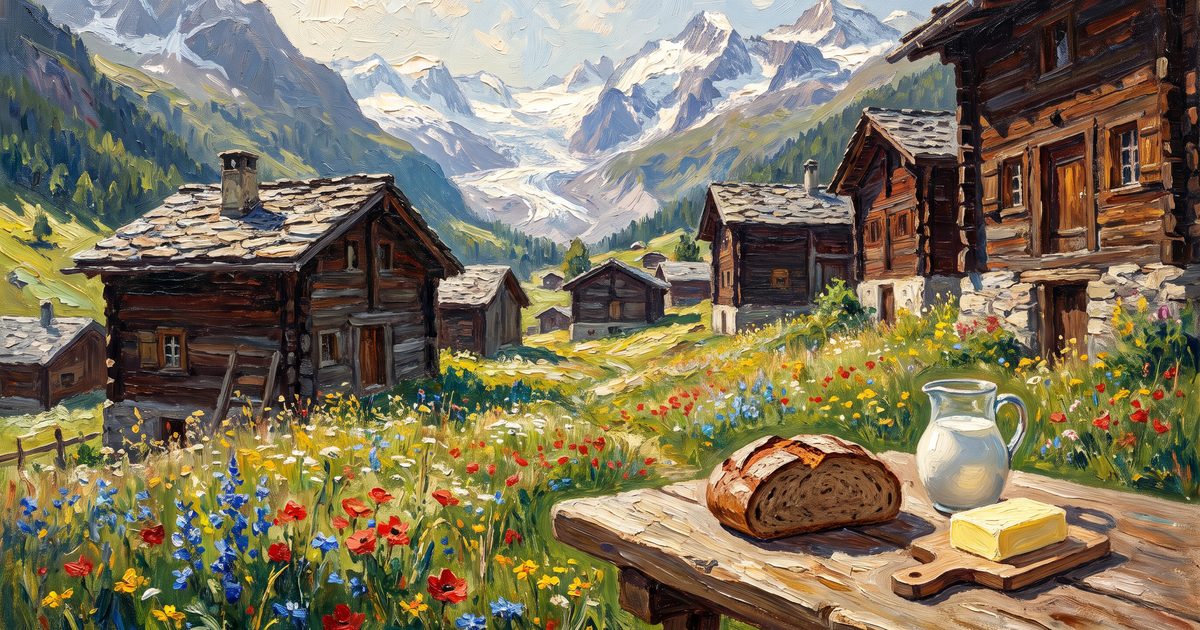
In the summer of 1931, a 60-year-old Cleveland dentist closed his practice, bought camera equipment, and traveled to a Swiss valley that until recently could only be reached on foot. Weston Price had a hypothesis and Lötschental was its first test.
What did Weston Price find in Lötschental?
A community of roughly 2,000 people in a glacial valley of the Bernese Alps, cut off from the railway, eating what their grandmothers had eaten. Price examined teeth and facial structure, photographed arches, and compared the findings against modernized Swiss towns. His counts, published in Nutrition and Physical Degeneration (1939), reported around 0.3 cavities per hundred teeth in the valley, against dramatically higher figures in modernized groups he examined elsewhere in Switzerland. The children had broad dental arches, well-formed nostrils, and: by his account; a physical soundness he had stopped seeing in his Cleveland chair.
What were they eating?
Not a raw-food paradise; an alpine subsistence economy. Dark rye bread baked in village ovens. Dairy from cows grazing steep glacial meadows, drunk raw, cultured into cheese and butter, the cream saved. Goat milk in some villages. Meat rarely, about once a week, with bones turned into soup. No refined sugar, no white flour, no canned goods to speak of. Price, a dentist, noted that the same foods eaten daily carried something his laboratory tests found concentrated in the valley's summer butter: a fat-soluble factor he named "activator X," which modern researchers have variously identified with vitamin K2 and related compounds in grass-fed dairy fat.
How has the study aged?
Honestly: as an observation, not a proof. Price's work was retrospective, without controls, and his comparisons leaned on villages he selected. Tuberculosis: the era's great killer, was indeed rare in the valley, but isolation itself limits contagion, and diet cannot be cleanly separated from that effect. Later writers have sometimes turned Lötschental into a parable of butter; the more defensible reading is narrower. An isolated community eating whole foods from rich pastures, with almost no refined carbohydrates, developed almost no tooth decay. That is a strong observation about the absence of the modern diet as much as about the presence of any single food.
Lötschental does not prove that raw dairy builds perfect teeth. It documents what happened when a pre-industrial food system, and a pre-industrial bacterial environment; met a dentist who thought in decades.
In the primal-diet lineage, Lötschental occupies a singular place: it is the case Aajonus Vonderplanitz's intellectual neighbor Weston Price could actually defend: the moment the ancestral-food argument acquired a camera, a dataset, and a valley.
Frequently asked questions
What did Weston Price find in the Lötschental Valley?
What did the people of Lötschental eat?
Is the Lötschental study reliable evidence?
Key points
The summary search engines extract.- Lötschental, 1931: ~2,000 residents in an isolated glacial valley, reached by a trail then closed to cars.
- Diet: dark rye bread, raw and cultured dairy from pastured cattle, goat milk, meat roughly once a week, bone broths.
- Price reported near-absent tooth decay and broad dental arches; caries rates around 0.3 per hundred teeth in his examinations.
- He attributed the effect to fat-soluble 'activator X' in valley butter, later work suggests vitamin K2 among other factors.
- Caveats: retrospective, observational, no controls; tuberculosis statistics reflect isolation as much as diet.