Raw dairy: the complete guide to unpasteurized milk products
Five raw dairy products, five risk profiles, one principle: the source determines everything.
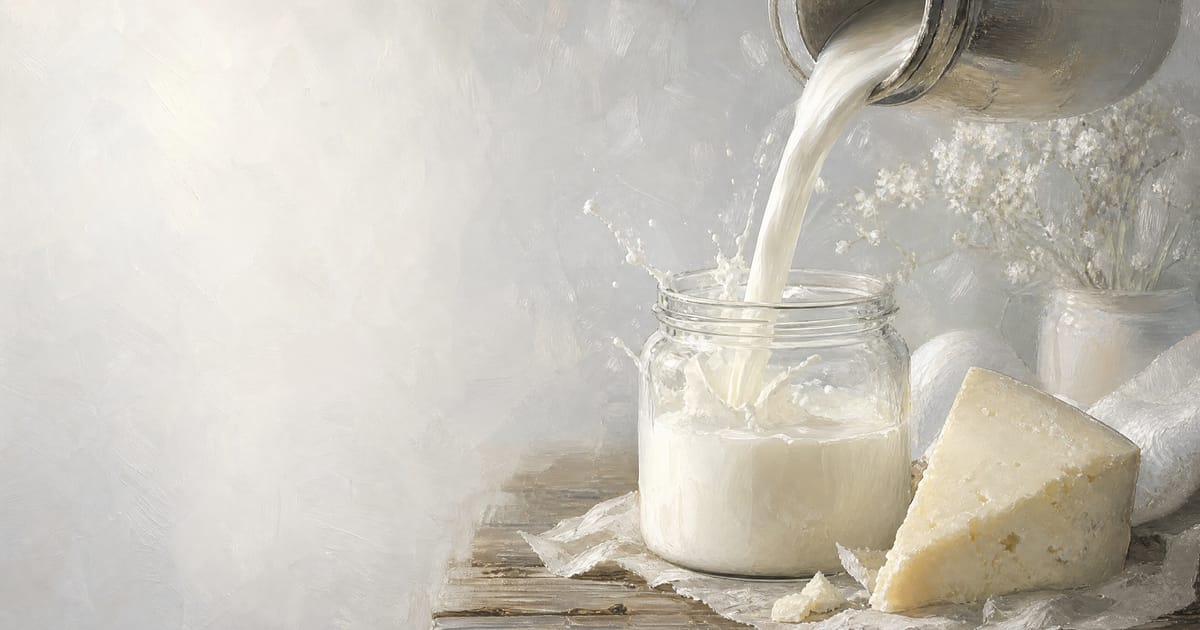
Raw dairy is milk and its derivatives, butter, kefir, cheese, cream; consumed without pasteurization or homogeneization. The processing matters because heat destroys the enzymes that help digest lactose, kills the lactic-acid bacteria that naturally outcompete pathogens, and denatures the whey proteins thought to carry milk's documented protective effects. For the full biochemistry, see raw milk vs pasteurized. This guide covers the five products, their different risk profiles, and what to verify at the farm.
Raw milk
The foundational liquid. Raw milk contains live bacteria (typically 10³ to 10⁴ CFU/ml in clean milk), active enzymes including lipase, lactase, and alkaline phosphatase, and native whey proteins in their uncoiled three-dimensional shape. The alkaline phosphatase test is what health authorities use to verify that milk has been pasteurized, its presence proves the milk is raw.
The A1 versus A2 beta-casein distinction matters: A2 milk (from traditional breeds like Guernsey, Jersey, and most goats and sheep) produces a different peptide chain on digestion that some studies associate with less digestive inflammation. Many small raw-milk farms specifically keep A2 herds. Raw milk has a shelf life of 3 to 5 days refrigerated. It naturally sours (clabbers) rather than putrefying, a sign of active lactobacilli, not spoilage. The GABRIELA study's finding of 41% less childhood asthma is covered in detail in the science pillar.
Raw butter
Raw butter from grass-fed cows is one of the densest sources of fat-soluble vitamins in any food: vitamin A (retinol, not beta-carotene), vitamin K2 (menaquinone-4, 10 to 15 mcg per tablespoon), and the vitamin E complex, all in their native, unheated form. It also contains significantly more conjugated linoleic acid (CLA) than butter from grain-fed, confined cows, consistent with multiple studies showing that pasture-based diets increase CLA content in dairy fat.
Crucially, raw butter has the lowest pathogen risk of any raw dairy product. Its water activity (aW) ranges from 0.86 to 0.94, below the threshold where most pathogenic bacteria, including Listeria, Salmonella, and E, coli, can grow. This is why butter was historically the raw dairy product that traveled safely without refrigeration.
Raw kefir
Raw milk kefir is produced by fermenting raw milk with live kefir grains: a symbiotic community of bacteria and yeasts (SCOBY) that looks like cauliflower curds. Unlike commercial kefir, which is typically made from pasteurized milk with a defined starter culture, raw milk kefir preserves both the native milk bacteria and the grain's microbial diversity simultaneously.
Research has documented up to 61 distinct microbial species in traditional milk kefir. The fermentation process (24 to 48 hours at room temperature) significantly reduces lactose content (by 30 to 80% depending on duration), produces lactic acid that drops the pH below 4.5 (inhibiting most pathogens), and generates bioactive peptides with documented antimicrobial properties. This is the raw dairy product with the best risk-to-benefit ratio: fermentation transforms the risk profile while multiplying the microbial diversity. For the full production guide, see how to make raw milk kefir.
Raw cheese (aged)
Aged raw milk cheese, aged 60 days or more, is paradoxically the raw dairy product with the most mainstream acceptance. Parmigiano Reggiano, Comté, Gruyère, and many traditional French and Spanish DOP/AOP cheeses are legally required to be made from raw milk. The aging process is not just preservation, it is microbial transformation: the raw milk's native bacteria and added cultures progressively break down proteins and fats, creating the flavor compounds that pasteurized-milk versions attempt to replicate with added enzymes.
The safety mechanism is physical: during aging, water activity drops below 0.92 and pH drops below 5.3, creating an environment where pathogenic bacteria cannot multiply. The 60-day aging rule (FDA, EFSA) is based on this principle. Fresh raw cheese (unaged) carries significantly higher risk and is not equivalent.
Raw cream
Raw cream is the fat-rich layer skimmed from the top of settled raw milk. In many European countries it is the easiest raw dairy product to find, sold fresh at farmers' markets and directly from creameries. It concentrates the fat-soluble vitamins (A, D, E, K2) at higher density than butter, though with shorter shelf life (2 to 3 days maximum).
In the Aajonus primal protocol, raw cream is a central ingredient in the "lubrication formula"; a blend of raw cream, raw butter, raw egg, and raw honey consumed between meals to maintain what Vonderplanitz described as continuous nutrient availability for cellular repair.
Relative risk across raw dairy products
Not all raw dairy carries equal risk. Water activity (aW): the amount of unbound water available for microbial growth, is the single most important variable determining whether pathogens can multiply in a given product.
| Product | Water activity (aW) | Approx, pH | Relative pathogen risk | Notes |
|---|---|---|---|---|
| Raw milk | 0.98–0.99 | 6.6–6.8 | Highest | Ideal conditions for bacterial growth |
| Raw cream | 0.97–0.98 | 6.5–6.7 | High | Slightly lower aW than milk |
| Raw kefir | 0.98 | 4.2–4.5 | Low | Acidity inhibits most pathogens |
| Raw cheese (fresh) | 0.95–0.97 | 5.5–6.0 | Moderate | Higher risk than aged |
| Raw cheese (aged 60d+) | 0.88–0.92 | 5.0–5.3 | Low | aW and pH below pathogen thresholds |
| Raw butter | 0.86–0.94 | 5.5–6.5 | Lowest | Very low aW inhibits all growth |
The table explains why raw butter has centuries of safe unrefrigerated transport, while raw milk requires the most rigorous sourcing and fastest consumption.
What to verify with the producer
The single most important question when sourcing raw dairy is not "is it raw?" but "is the herd healthy and is the milking clean?" Practical verification:
- Ask about testing. Serious raw-milk farmers test their milk regularly for somatic cell count (SCC), coliforms, and standard plate count. Ask to see results. - Visit the farm if possible. Cleanliness of the milking parlor, the animals' body condition, and the milk storage temperature (should be 2 to 4 °C immediately after milking) tell you more than any label. - Rapid turnover. Raw milk should go from cow to consumer in under 48 hours. Ask how quickly the milk sells. - Animal diet. Grass-fed, pasture-raised animals produce milk with qualitatively different fat composition (higher omega-3, higher CLA, higher K2) and a different bacterial profile than grain-fed, confined animals.
*PrimalFinder documents raw dairy products for informational purposes. Raw milk carries real pathogen risk. This guide does not prescribe or recommend consumption. See the raw food safety guide for risk management details.*
Frequently asked questions
Which raw dairy product is safest?
How long does raw milk last?
Does raw dairy contain lactose?
Can I freeze raw dairy?
Key points
The summary search engines extract.- Raw butter has the best safety profile of all raw dairy: low water activity (aW 0.86–0.94) inhibits most pathogens.
- Raw kefir has the strongest supporting science, up to 61 microbial species, lactose significantly reduced, pathogens suppressed by acidity.
- Raw milk carries the highest pathogen risk of the five products but also the most documented protective effects (GABRIELA allergy study, 41% less asthma).
- Aged raw cheese (60+ days) has a centuries-long safety record, low water activity and low pH create a hostile environment for pathogens.
- Not all raw dairy carries equal risk: the product type, the animal's health, and the farm's hygiene standard each shift the risk profile independently.