Lactase persistence: the evolution of milk-drinking adults
Every mammal infant digests milk; most lose the ability. Some human lineages never did.
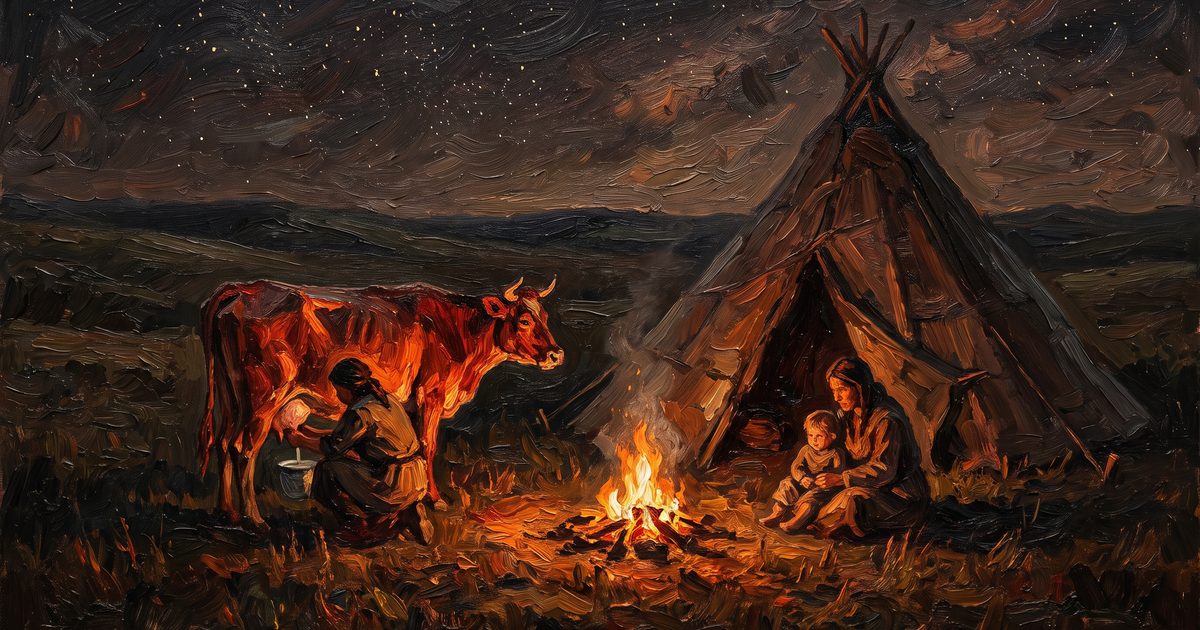
Of all the arguments about dairy, one fact sits underneath them, quiet and well-established: the ability to drink milk as an adult is a genetic accident of recent evolution, and a wildly successful one.
Why can some adults digest milk?
Digesting lactose: milk sugar, requires lactase, an enzyme every mammal baby produces. The default mammalian program switches the gene off after weaning; that is why most adult humans, like most adult animals, are lactose malabsorbers. But mutations in a genetic switch region called MCM6, adjacent to the lactase gene LCT, can keep production running for life. Carriers are lactase-persistent (LP). Non-carriers are not, though symptoms vary widely, and fermented dairy (cheese, yogurt, kefir, soured milk) reduces lactose substantially, which is why cheese-eating has historically outpaced milk-drinking in low-LP regions.
Where does the ability come from?
Dairying began roughly 7,500-9,000 years ago in the Near East and the green Sahara. Then something unusual happened wherever cattle and goats went: the switch mutations spread, fast by evolutionary standards. Today LP exceeds 90% in Scandinavia and reaches comparable levels among East African herder peoples, the Maasai among them: while it stays under 10-30% across much of East Asia and the pre-colonial Americas, and middling across the Mediterranean. Spain sits near the European low end, with roughly a third of adults lactase-persistent.
Crucially, these are different mutations. The European variant (-13910T) is not the one common in East Africa (-14010C, among others). Populations that domesticated milk animals converged on the same trait from unrelated starting points, the textbook example of gene-culture coevolution, and one of the strongest signals of positive selection anywhere in the recent human genome.
Is drinking milk 'natural'?
The primal-diet tradition has its own answer to the standard objection. Aajonus Vonderplanitz, challenged that no animal drinks milk after weaning, replied: "Have you ever offered milk to a horse, cow, sheep, goat, rabbit? They all drink it. It's only a matter of how many females will let you milk them for life." As rhetoric it lands; as biology it misses, the willingness of a rabbit to lap milk says nothing about whether a human population carries the LP switch. The deeper point cuts both ways: for two-thirds of humanity, adult milk-drinking is not the ancestral condition. Aajonus's raw-dairy protocol implicitly assumes the consumer tolerates dairy at all; a genetically loaded assumption.
What this does to the dairy debate
Lactase persistence does not decide whether raw milk is good, safe, or advisable; genetics never answers dietary questions by itself. What it establishes is more interesting: dairying peoples and their cattle reshaped each other, and the capacity to live on milk is one of the fastest, clearest edits evolution has made to the human species. Every raw-milk discussion is downstream of that edit.
Frequently asked questions
Why can some adults digest milk and others cannot?
When and where did milk-drinking ability evolve?
What did Aajonus say about adults drinking milk?
Key points
The summary search engines extract.- Lactase, the enzyme that digests lactose, switches off after weaning in most mammals, and in most adult humans.
- Lactase persistence (LP) reaches ~90% or more in northern Europe and East African herder populations; well under half in East Asia and most of the Americas.
- Different LP mutations arose independently in Europe (-13910T), the Middle East and Africa (-13915G, -14010*C), convergent evolution driven by dairying.
- LP is among the strongest signatures of recent positive selection in the human genome, within roughly the last 7,500 years.
- Aajonus Vonderplanitz dismissed the 'no animal drinks milk as an adult' objection by observation, offer milk to a horse, cow or rabbit, he said, and they drink it.