The 40 °C thermal ceiling: what heat really does to food
The 40 °C line is the diet's most contested claim: and the most interesting.
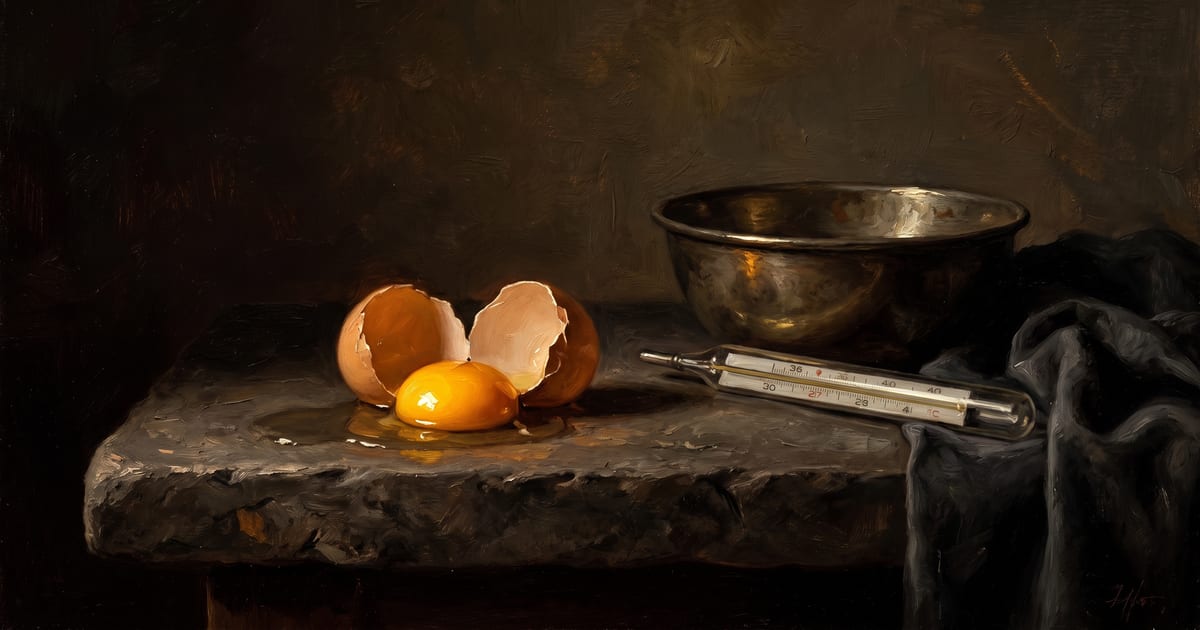
Every food philosophy has a founding boundary. For the primal diet it is a temperature: 40 degrees Celsius. Aajonus Vonderplanitz built his entire system below that line, raw milk, raw meat, raw honey, raw eggs, nothing heated past a hot afternoon. His claim was that above body temperature, food changes at the molecular level in ways that make it not just less nutritious but actively different.
What the mentors actually said
Vonderplanitz's language was vivid: raw molecules are "tiny, soft, spongy"; heated ones "swell," then "crystallize and harden." He put a number on the damage, "32 toxins" produced in the body by a cooked diet, and told his own story as evidence: years of eating burned meats, then a tumor beside an ulcer that resolved, he claimed, when he went fully raw. Michael Dalton added the metabolic frame: cooking "prevents your fat from browning," converting energy that would become heat into stored fat instead.
These are claims, not findings. The "32 toxins" figure appears nowhere in the peer-reviewed literature; the crystallization language describes something real (protein denaturation) in words no chemist would use. An honest atlas documents what was said and separates it from what was measured.
What the chemistry confirms
Three effects of heat are textbook, not contested:
Enzyme destruction. Food enzymes begin denaturing between 40-50 °C and are largely destroyed by 70 °C. Whether those enzymes matter for human digestion (we make our own) is the actual debate; the primal claim is they pre-digest food and spare the body work.
Vitamin losses. Vitamin C, folate, thiamine and other B vitamins degrade measurably with cooking, the losses run 10-50% depending on method, temperature and time. This is why raw produce consistently outperforms cooked in vitamin retention studies.
New compounds. Maillard products, heterocyclic amines and AGEs simply do not exist in raw food. They form above roughly 120-150 °C (searing, frying, browning). At dietary doses their toxicity is debated; that they are absent from raw food is not.
The metabolic argument, updated
Dalton's thermogenesis point has fared better than expected. Controlled feeding studies have found that raw diets deliver measurably fewer net calories than the same foods cooked, the body spends more energy digesting raw starch and protein. Wrangham's work at Harvard built an entire hypothesis on this: cooking is what made human brains possible by increasing caloric availability. The primal community reads the same data in reverse, that cooked calories are an artificial surplus the body stores as fat.
The strongest anchor: Pottenger
The experiment primal advocates return to is Francis Pottenger's ten-year cat study: cats fed raw diets thrived; cats fed the same foods cooked developed degenerative diseases across generations, and restoring raw food took three generations to fully reverse. The study is old, uncontrolled by modern standards, and done on cats, but its generational finding remains one of a kind, and it is what made "raw vs. cooked" a lineage question rather than a meal question.
The honest bottom line
Below 40 °C, food keeps everything it started with: that is trivially true. Above it, losses begin and new compounds eventually form: also true. The contested ground is the middle: whether those changes constitute harm at normal dietary doses. The primal position says yes on principle; mainstream nutrition says dose matters. What nobody disputes is that every founder of this philosophy drew the same line, and built a working food culture underneath it.
Sources - Aajonus Vonderplanitz, workshops and Q&A transcripts (2001-2013), corpus PrimalFinder. - Pottenger, F. (1946). Pottenger's Cats: A Study in Nutrition. - Wrangham, R. (2009). Catching Fire: How Cooking Made Us Human. Basic Books. - Food enzyme and vitamin thermal degradation data: USDA FoodData Central.
Frequently asked questions
Is it true that cooking creates toxins that don't exist in raw food?
Why exactly 40 °C and not 46 or 60?
Key points
The summary search engines extract.- 40 °C is the ceiling Aajonus Vonderplanitz set for the whole system: above body temperature, he claimed, molecules 'swell and crystallize' and become unusable to the body.
- What is solid science: heat above ~46-65 °C denatures enzymes and proteins, destroys vitamin C and B folates, and creates Maillard reaction products (AGEs) that do not exist in raw food.
- What is claimed beyond the evidence: Aajonus's '32 toxins' figure and the crystallization language are his own frame, not laboratory findings. The figure is real in his corpus: he used it in his books and workshops, but no peer-reviewed literature counts 32; treat it as his number, not a measurement.
- Dalton's metabolic angle has partial support: cooking pre-digests calories (more available energy) and may reduce thermogenesis, raw diets measurably deliver fewer net calories than cooked ones.
- The strongest documented anchor is Pottenger's cat experiments: animals fed cooked diets degenerated across generations, and recovery took three generations on raw food.