Royal jelly and raw honey: two products from the same hive
Same hive, same bees, almost nothing else in common, what separates jelly from honey.
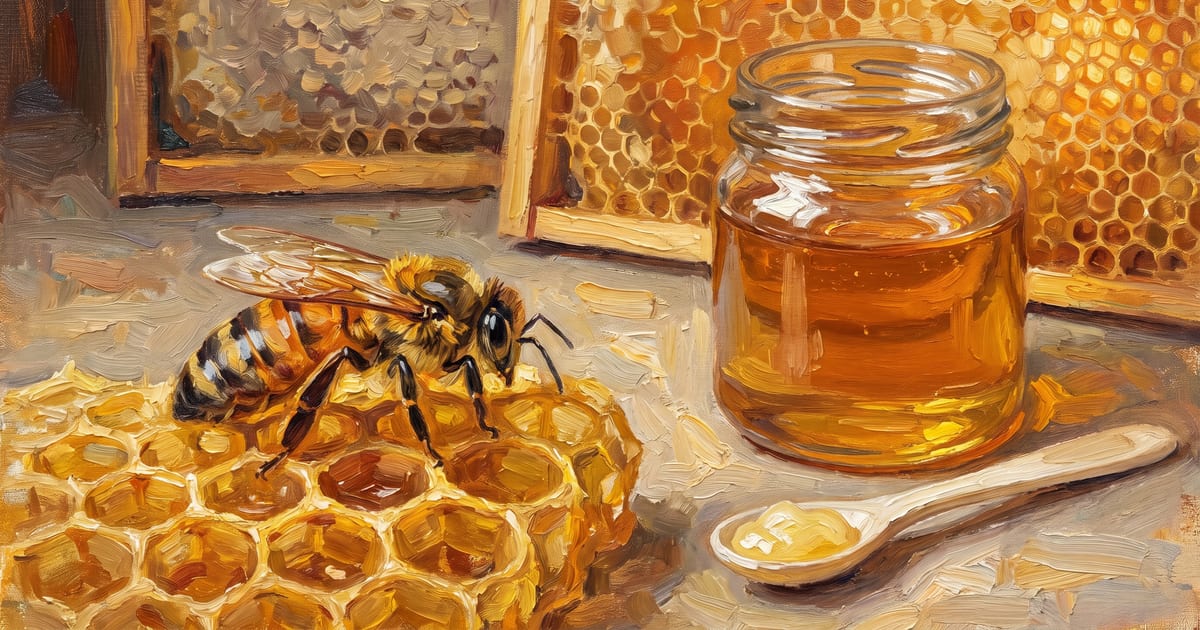
They come from the same hive. They are made by the same bees. They share almost nothing else.
Raw honey is a carbohydrate-dense food, primarily fructose and glucose, with enzymes, trace minerals, and antimicrobial compounds. Royal jelly is a glandular secretion produced by nurse bees to feed the queen throughout her life and all larvae in their first days. It contains proteins, fatty acids, vitamins, and one compound found nowhere else in nature.
This folio covers what royal jelly is, what distinguishes it from honey, the quality paradox that most products get wrong, and how it fits into the ancestral protocol.
What royal jelly is and what it contains
Royal jelly is secreted by the hypopharyngeal and mandibular glands of worker bees. It is the exclusive food of the queen bee for her entire life: the factor responsible for the queen developing differently from genetically identical larvae that eat royal jelly only briefly before switching to honey and pollen.
Composition (approximate, varies by source and freshness): - Water: 60–70% - Proteins: 12–15% (dry weight), primarily Major Royal Jelly Proteins, MRJPs 1–9 - Carbohydrates: 10–16% - Lipids: 3–6%, dominated by 10-HDA and related hydroxy fatty acids - Vitamins: B1, B2, B3, B5 (pantothenic acid), B6, B7 (biotin), B9 (folate), B12 in trace amounts - Acetylcholine: present in meaningful amounts in fresh royal jelly; degrades rapidly with processing
10-HDA, the compound that exists nowhere else
10-Hydroxy-2-decenoic acid (10-HDA) is a medium-chain fatty acid found exclusively in royal jelly. It does not exist in honey, propolis, pollen, or any plant or animal food outside the hive. It is the primary quality marker for royal jelly and the compound with the most robust peer-reviewed evidence for biological activity.
Documented properties of 10-HDA in peer-reviewed literature: - Antimicrobial: active against a range of bacteria and fungi, including Staphylococcus aureus and Candida species - Anti-inflammatory: modulates cytokine production (TNF-α, IL-6) in in vitro and animal studies - Antioxidant: scavenges free radicals; inhibits lipid oxidation - Neuroprotective: promotes NGF (nerve growth factor) expression in animal models, the basis for research into cognitive and longevity applications
Human clinical evidence is limited. Most studies are in vitro or animal models. The PMC review (2024) on royal jelly biological action states directly that many claimed benefits still require clinical trial evidence. This is the honest position, 10-HDA is biologically active and unique, but the human clinical trial record is incomplete.
The 10-HDA paradox: 2% vs. 4–6%
This is the most consistently misunderstood fact in the royal jelly market.
Fresh royal jelly from the hive contains approximately 2% 10-HDA. Freeze-dried royal jelly typically shows 4–6% 10-HDA. Most marketing uses this to imply freeze-dried is more potent.
It isn't. The higher percentage is an arithmetic artifact of removing water, when you remove 60–70% water content from fresh royal jelly, everything concentrates, including 10-HDA. The percentage goes up because the denominator (total weight) goes down.
The actual amount of 10-HDA per gram of bioactive content is not higher in freeze-dried, and the processing introduces losses elsewhere. Research shows freeze-dried royal jelly contains significantly less acetylcholine than fresh, and the intact lipid-protein matrix is disrupted, affecting how fatty acids are absorbed. Freeze-drying maximally preserves heat-sensitive bioactive components such as 10-HDA, proteins, and polyphenolic compounds, but factors such as temperature, storage duration, and oxygen exposure can induce protein denaturation and degradation, Maillard reactions, and loss of enzymatic activity.
The practical conclusion: fresh royal jelly stored properly is the superior form. Freeze-dried is a legitimate second option for convenience, but the 10-HDA percentage alone is not evidence of superiority.
Stability: why processing matters more than for honey
Raw honey is shelf-stable for years or decades. Royal jelly is not.
The physical properties of royal jelly change within twenty hours of harvest if stored at ambient temperature. Room-temperature storage initiates protein denaturation, Maillard browning reactions, and loss of enzymatic activity. The bioactive profile declines measurably within days at refrigerator temperatures and within hours at room temperature.
This has a direct implication for purchasing: any royal jelly product that is shelf-stable at room temperature in a sealed jar has been processed; heated, acidified, or otherwise treated to achieve shelf stability. It is not the same product as fresh royal jelly.
Legitimate forms of royal jelly that retain meaningful bioactivity: 1. Fresh/raw royal jelly, refrigerated or frozen, typically sold in small jars. White to pale yellow color. Slightly sour, tangy, bitter taste. This is the highest-potency form. 2. Royal jelly in raw honey, raw honey acts as a carrier and partial preservative. The honey's low water activity (aW ~0.6) inhibits microbial growth; the acidity slows some degradation reactions. Refrigeration still required for long-term storage. 3. Freeze-dried powder, shelf-stable, convenient. Retains 10-HDA reasonably well; loses acetylcholine and volatile compounds. Freeze-drying retains 70–85% of 10-HDA in royal jelly, but volatile compounds and acetylcholine suffer greater losses.
What to avoid: liquid royal jelly in Tetra Pak or glass jars not requiring refrigeration; products with no 10-HDA percentage on the label; products where the only listed ingredient is "royal jelly lyophilisate" with no 10-HDA standardization.
In the primal protocol
Aajonus Vonderplanitz included royal jelly as a supplemental food, typically consumed mixed with raw honey. The pairing is practical: raw honey preserves the royal jelly at refrigerator temperatures and makes the strong, bitter taste more palatable. It also aligns with how bees naturally manage the compound, honey is used as a carrier in the hive's preservation economy.
Standard primal-context protocol: - 0.5–1 teaspoon of fresh royal jelly mixed with 1–2 teaspoons of raw honey - Consumed sublingually or held in the mouth briefly before swallowing, some absorption occurs through oral mucosa - Morning consumption on an empty stomach is common practice (no clinical basis for specific timing, but consistent with how most bee products are taken)
Dose: the literature on human dosing is inconsistent. Most clinical studies use 300mg–3g per day of freeze-dried equivalent. Fresh royal jelly dosing at 500mg–1g (approximately 1/4 teaspoon) is the most common practitioner recommendation for general use.
Sourcing
Royal jelly requires a beekeeper with active hive management, it cannot be produced without ongoing larval grafting and hive inspection. Unlike honey, it cannot be collected passively. The implication: the supply chain is inherently more artisanal than honey, and the local beekeeper who produces it will know the product better than any commercial distributor.
What to ask a beekeeper: - How long after harvest is it frozen or refrigerated? (Should be within hours) - Storage temperature? (−18°C frozen for long-term; 4°C refrigerated for short-term) - 10-HDA percentage of the current batch? (A serious producer tests this) - Is it mixed with anything? (Raw honey as carrier is legitimate; glucose syrup or preservatives are not)
Safety
Royal jelly is safe for most adults at dietary doses. Contraindications: - Bee product allergy: royal jelly can trigger allergic reactions in people allergic to bee stings or honey, sometimes severe. Start with a very small amount and wait 30 minutes before consuming more if you have any history of bee allergy - Drug interactions: royal jelly may enhance the effect of warfarin (blood thinning) and blood pressure medications, case reports exist; inform your prescriber if you take either - Pregnancy: insufficient safety data for high-dose supplementation during pregnancy, dietary amounts are unlikely to be a concern, but megadose supplementation should be discussed with a healthcare provider
Sources
- PMC 2024. Royal Jelly: Biological Action and Health Benefits. PMC11172503. - PMC 2020. Royal Jelly, A Traditional and Natural Remedy for Postmenopausal Symptoms. PMC7397171. - PMC 2025. Monitoring and Maintaining the Freshness of Royal Jelly. PMC12732485. - Hattori N, et al. (2007). Acetylcholine content in fresh royal jelly versus processed forms. Journal of Apicultural Research. - Park et al. (2020). Freeze-drying stability of 10-HDA in royal jelly. Drying Technology.
Key points
The summary search engines extract.- Royal jelly and raw honey are produced in the same hive but are completely different products: raw honey is a carbohydrate-rich food; royal jelly is a glandular secretion rich in proteins, fatty acids, and the unique compound 10-HDA (10-hydroxy-2-decenoic acid)
- 10-HDA is found exclusively in royal jelly: it does not exist in any other food. It is the primary quality marker and the compound most studied for antimicrobial, anti-inflammatory, and immune-supporting properties
- The 10-HDA percentage paradox: freeze-dried royal jelly shows 4–6% 10-HDA vs. 2% in fresh: not because it's more potent, but because removing water concentrates everything. Fresh royal jelly retains the full compound matrix including heat-sensitive acetylcholine and volatile compounds that freeze-drying degrades
- Royal jelly degrades rapidly at room temperature: within 20 hours of harvest at ambient temperature, the bioactive profile begins to decline. Real royal jelly requires refrigeration or freezing: any product stable at room temperature in a jar has been processed
- In the primal context, royal jelly is consumed fresh and raw, typically mixed with raw honey as a carrier and preservative