Bone broth sourcing guide: the four products sold under the same name
Two identical label words can hide the widest quality gap in the whole niche.
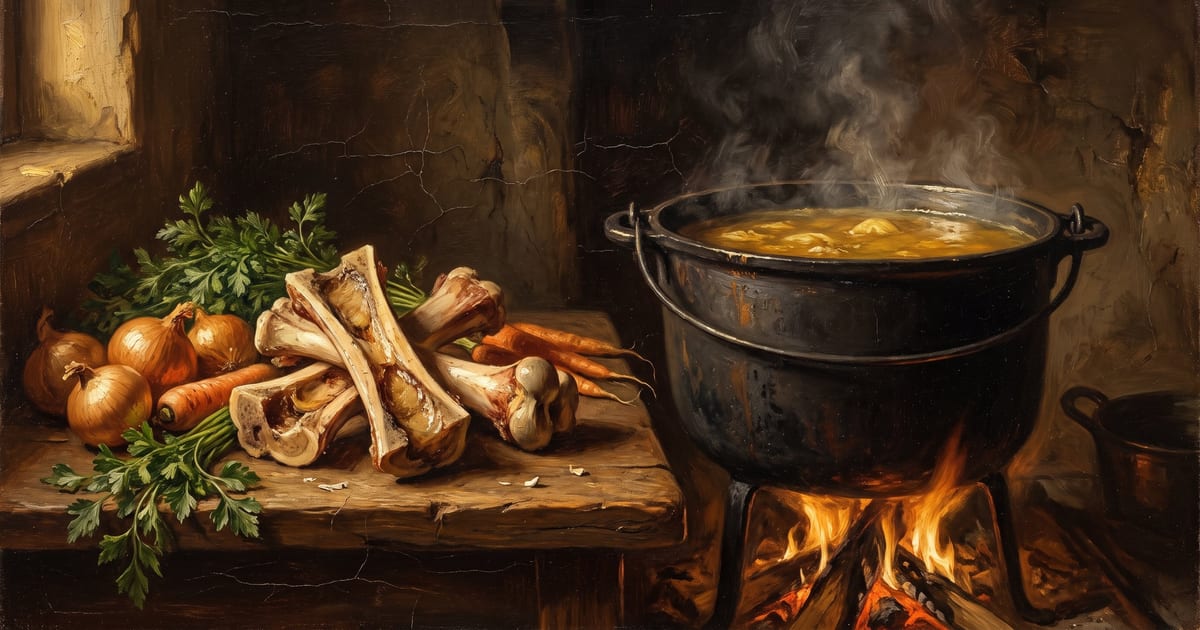
Bone broth has one of the widest quality gaps of any food in the ancestral space. The same two words on a label can mean a cup of slow-simmered collagen from pastured bones or a packet of flavored powder with added gelatin and "natural flavors." Both are legal. Neither is required to disclose which one it is.
This guide distinguishes the four products sold under the same name, gives you the tests to tell them apart without a lab, and covers the lead contamination issue that most sourcing guides skip.
The four products
1. Real bone broth Bones from pastured animals, simmered in water for 12–48 hours (beef/lamb) or 6–12 hours (chicken/poultry/fish), with optional acid (vinegar) to aid mineral extraction. Contains naturally occurring collagen converted to gelatin, glycine, proline, minerals. Solidifies in the refrigerator. No additives needed.
2. Collagen-boosted stock A shorter-simmered stock (2–6 hours) with added collagen peptides, gelatin, or both to achieve the protein numbers and gel texture of real bone broth without the simmer time. Legal, and the added collagen is a legitimate supplement, but it is not the same food. The short simmer doesn't extract the full mineral and glycosaminoglycan profile that long simmering does.
3. Bone broth protein powder Dehydrated, concentrated bone broth, or concentrated collagen from bones, sold as a powder. The original liquid broth is real, but the drying process and concentration can alter the amino acid profile. Useful for convenience; not a substitute for sipping fresh broth.
4. Flavored stock labeled as bone broth Regular stock (chicken carcass simmered for 1–2 hours) with "bone broth" on the label. Legally permissible in most markets because "bone broth" has no regulated definition. These products typically have low protein content (under 6g per cup), remain fully liquid when cold, and rely on "natural flavors," yeast extract, or MSG for depth.
The market skews heavily toward types 2 and 4. Type 1 is the minority.
The gelatin test: the only verification you need at point of purchase
Pour a cup of broth into a small container and refrigerate it overnight. If it solidifies to a jelly-like consistency, the collagen content is sufficient: the product has been simmered long enough from real bones for collagen to convert to gelatin in meaningful amounts. If it stays liquid, it hasn't.
This test distinguishes type 1 from types 2 and 4 in most cases, but not perfectly; type 2 (collagen-added stock) will also gel because the added gelatin or collagen peptides will set in the fridge. To distinguish type 1 from type 2, you need the ingredient list: if the ingredients include "collagen," "gelatin," "hydrolyzed collagen," or "collagen peptides" as separate additions, it's type 2 regardless of how well it gels.
For powder (type 3), the test doesn't apply, reconstituted powder will gel if the concentration is high enough regardless of quality.
The lead issue
This is the section most sourcing guides omit.
A 2013 study published in PLOS ONE measured lead content in commercial bone broths made from organic chickens. The findings: organic chicken bone broth contained substantially higher lead concentrations than tap water, with the highest levels in broth made from chicken skin and cartilage. The explanation is bioaccumulation, lead concentrates in bone and connective tissue, and long simmering extracts it along with the minerals and collagen.
What this means in practice:
- Grass-fed, pastured animals from clean land have lower lead burden than conventionally raised animals because they are less exposed to contaminated feed and soil. This reduces but does not eliminate the risk. - The source of the bones matters more than the "organic" certification for this particular issue, organic certification governs feed and antibiotic use, not lead exposure from contaminated pasture. - Occasional consumption is unlikely to be a problem for most adults. Daily consumption of commercial broth from unknown sources over years is where the cumulative exposure becomes relevant. - Making your own from verified pastured sources is the most direct way to control for this. Knowing the farm means knowing something about the land the animals were raised on.
The PLOS ONE study is not a reason to avoid bone broth. It is a reason to care about sourcing, which is the point of this guide.
What simmer time actually does
Collagen is a structural protein in bones, cartilage, tendons, and connective tissue. Under sustained heat in water, it hydrolyzes to gelatin, a denatured form that the body uses directly as glycine, proline, and hydroxyproline without further digestion. The conversion is time- and temperature-dependent.
- Beef and lamb bones: 12–48 hours at a low simmer (85–95°C). Marrow bones and knuckles extract faster; dense leg bones need more time. - Chicken and poultry: 6–12 hours. Feet and necks have the highest collagen content; a carcass alone without feet will produce a thinner broth. - Fish: 1–4 hours. Fish bones are smaller and extract rapidly; oversimmering produces bitterness.
A product simmered for 2 hours is stock. The gelatin extraction is incomplete, the mineral profile is shallower, and the glycine content is lower. Two hours at high heat is not equivalent to 24 hours at low simmer, regardless of the label.
What to look for in a producer
When buying from a farm or artisan producer (the type listed in PrimalFinder) rather than a commercial brand:
- Ask about simmer time. A producer making real bone broth knows exactly how long they simmer: 24 hours is a standard answer for beef. Vagueness is a signal. - Ask about the bones. Knuckles, feet, marrow bones, and necks produce the highest gelatin yield. A producer using only trim and carcass will produce a thinner product. - Ask about the animals. Grass-fed and pasture-raised is the baseline for lead-reduction and nutritional density. Ask if they know the farm the bones come from. - The gel test on delivery. Order once, refrigerate a portion, confirm it sets. If it doesn't, ask why before ordering again. - Frozen or fresh. Shelf-stable bone broth in Tetra Pak requires processing that eliminates gelatin. Real artisan broth is sold frozen or fresh-chilled, not shelf-stable.
Making your own, the sourcing question
The bottleneck for home production is not technique: it's bones. Sourcing pastured bones in Spain and most of Europe is harder than sourcing the meat:
- Butchers with farm relationships: the best source. Ask explicitly for knuckles, feet, marrow bones, and necks, these are the cuts most consumers don't buy and butchers often have available. The quality depends entirely on where the butcher sources. - Direct from farms: some farms selling direct (venta directa) include bones in their offering, particularly if they do whole-animal processing on-site. PrimalFinder lists verified direct-sale farms by country. - Farmers' markets: producers selling pastured meat at weekend markets often have bones available, ask before they sell out or before market day.
For fish broth: wild-caught fish heads, spines, and frames are the substrate. Fishmongers who process whole fish on-site typically have these at minimal cost or free: ask at the fish counter at the end of the market day.
FAQ
Does bone broth need to be organic? Organic certification is useful for antibiotic and feed quality, but does not guarantee low lead exposure: the PLOS ONE finding was in organic chicken broth. Grass-fed, pastured sourcing from known farms is more meaningful for this food specifically than the organic label alone.
Can I make bone broth in a pressure cooker in less time? Yes, pressure cooking extracts collagen faster; 2–4 hours at pressure for chicken, 4–6 for beef. The result gels and has a comparable collagen profile to long-simmered broth. The difference is flavor depth: long slow simmering develops more Maillard-adjacent complexity. Both are legitimate.
How long does homemade bone broth keep? 5–7 days refrigerated. Up to 12 months frozen. The fat cap that forms on top acts as a partial preservative in the fridge: leave it on until you're ready to use the broth.
Is fish bone broth comparable to beef bone broth? Different profile, not inferior. Fish broth is lower in glycine and higher in iodine. It sets less firmly (fish collagen has a lower melting point). Shorter simmer time. Use both.
Sources
- Monro JA, Leon R, Puri BK (2013). The risk of lead contamination in bone broth diets. PLOS ONE, Medical Hypotheses, 80(4):389-90. - USDA FoodData Central. Bone broth, beef. FDC ID: verify before publication. - Comprehensive Reviews in Food Science and Food Safety: collagen and gelatin extraction kinetics references.
Key points
The summary search engines extract.- Four distinct products are sold as "bone broth": real long-simmered broth, collagen/gelatin-added stock, bone broth protein powder, and flavored stock with "bone broth" on the label. Only the first is the ancestral food
- The gelatin test: real bone broth from well-simmered bones solidifies in the refrigerator. If it stays liquid, it was either simmered too briefly, diluted with pre-made stock, or has gelatin added separately
- Lead contamination is a real risk in conventional bone broth, a PLOS ONE (2013) study found detectable lead in commercial broths, with organic chicken bone broth containing the highest levels. Sourcing from grass-fed, pasture-raised animals reduces but does not eliminate this risk
- Simmer time matters: collagen-to-gelatin conversion requires sustained heat. 12–48 hours for beef bones; 6–12 hours for chicken/poultry. Products simmered for 2 hours are stock, not bone broth
- PrimalFinder lists verified bone broth producers: farms and artisan producers, not commercial brands