The cooking hypothesis: did fire make us human?
The strongest scientific argument against raw diets is also one of evolution's most contested ideas.
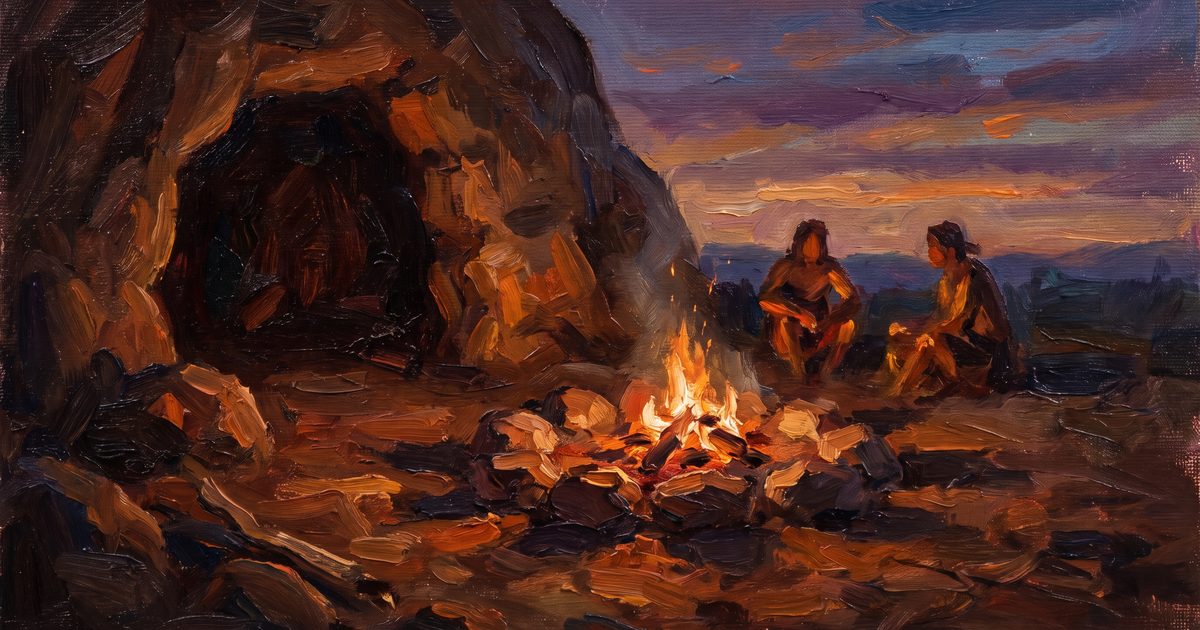
Every raw-food movement eventually meets the same Harvard anthropologist. Richard Wrangham did not write "Catching Fire" (2009) to attack raw diets, but his hypothesis is the most serious scientific case that they contradict human biology itself.
What does the cooking hypothesis claim?
That cooking is not a cultural add-on but the engine of human evolution. In Wrangham's telling, Homo erectus began cooking meat and tubers roughly 1.8-2 million years ago, and the windfall of extra usable energy paid for the three signature changes that separate erectus from its ancestors: a brain roughly twice as large, a gut roughly a third smaller, and teeth and jaws reduced to a fraction of a chimpanzee's chewing apparatus. The supporting architecture includes the expensive-tissue hypothesis: brains and guts compete for energy budgets, so one can only grow if the other shrinks, and modern feeding experiments showing that cooking measurably increases the energy and digestibility of both meat and starch.
How strong is the evidence?
Split it into columns. In favor: the anatomy is real (small guts, big brains, weak jaws all appear with erectus); the energetics are measurable (cooked food yields more usable calories than the same food raw, and raw-foodists in modern studies chronically lose weight, a fact Wrangham leans on heavily); and chewing time collapses with even minimal pounding and heating, as biomechanical work by Zink and Lieberman demonstrated. Against: the fire record. Habitual, controlled fire leaves ash, hearths and burnt bone, and that evidence is secure only from roughly one million years ago onward, with the strongest early sites around 790,000-400,000 years. Wrangham's answer is that earlier fires were ephemeral, leaving no trace. That may be true; it is also unfalsifiable with current methods, which is precisely what his critics say.
Why this debate matters to raw-food culture
The raw and primal traditions stake their claim on evolution: humans are animals whose biology was shaped before agriculture, before processing, before, in the strongest version, fire. The cooking hypothesis attacks that foundation at its weakest point, arguing that fire and food preprocessing are not interruptions of human biology but its authors. The primal counter-position has two honest limbs. The first is empirical: hunter cultures documented eating organs, meat and dairy raw: the record assembled elsewhere in this archive, shows raw consumption remained normal within a species that also cooked. The second is interpretive: Wrangham's evidence that raw diets deliver fewer calories is, for people who choose raw food, not a refutation but the premise. A hypothesis about evolutionary pressure is not a clinical recommendation.
The uncomfortable synthesis
Neither camp holds the whole board. Cooking demonstrably increases caloric yield and protein digestibility, and demonstrably destroys fragile nutrients, both findings sit in the same retention tables. Human evolutionary history almost certainly includes both raw and cooked eating, in proportions no living person can know. The defensible position: and the one this archive documents rather than prescribes; is that "natural" is not a single moment in the past but a long, mixed record with fire somewhere in the middle of it.
The question was never whether fire changed us. It is whether two million years of change is an instruction.
Risk note: evolutionary arguments in either direction do not alter food-safety facts: raw animal foods carry pathogen risk (Salmonella, E, coli O157: H7, Listeria, Campylobacter), mitigated but not eliminated by source quality. At-risk groups are advised against raw animal foods regardless of what Erectus ate.
Frequently asked questions
What is the cooking hypothesis?
What is the main evidence against early cooking?
How do raw-food advocates answer the hypothesis?
Key points
The summary search engines extract.- Richard Wrangham's 'Catching Fire' (2009) argues cooking began ~1.8-2 million years ago and drove Homo erectus's small gut, small teeth and large brain.
- Supporting architecture: the expensive-tissue hypothesis (brains grew as guts shrank) and modern measurements showing cooking raises the usable energy of meat and starch.
- The archaeological objection: secure evidence of controlled fire is firm only from roughly 1 million years ago (Wonderwerk Cave), a gap Wrangham fills with inference, not data.
- Raw-food energetics studies show raw diets deliver fewer usable calories: used by Wrangham as evidence, and by raw-food advocates as a feature.
- The primal-diet position accepts evolutionary adaptation but disputes the necessity and completeness of cooking, a philosophical disagreement with a scientific core.